
A Simple Guide to British Standards: BS 5839, BS EN 54 and What UK Businesses Need to Know
Last updated: April 2026
British Standards (BS) are technical documents published by the British Standards Institution (BSI) that set the benchmarks for safety, performance and quality across UK industry. For fire and security, the ones that matter most are BS 5839 (fire detection and alarm systems), BS EN 54 (fire alarm components) and BS EN 50131 (intruder alarms). Compliance is usually voluntary in law but contractually and commercially unavoidable.
British Standards sit quietly behind almost everything in a commercial building — the wiring in the riser, the fire alarm panel on the wall, the emergency lighting in the stairwell, even the concrete in the floor slab. For most UK businesses, they only become visible when an insurer, a tender document or a fire risk assessor asks whether a system conforms to BS 5839, BS EN 54 or one of the other fire and security standards. This guide explains what British Standards actually are, how they are written, which ones matter for fire and security, and what happens when a building does not comply.
What Are British Standards?
British Standards are technical specifications, codes of practice and guidance documents issued by the British Standards Institution (BSI). BSI has been the UK’s designated National Standards Body since 1901 and is the oldest national standards body in the world. Every standard carries a unique reference — “BS” followed by a number — sometimes with an “EN” prefix where the standard mirrors a European one, or “ISO” where it aligns with an international one.
A British Standard is not, by itself, a law. In most cases, compliance is voluntary. But in practice, BS numbers turn up in:
- Building contracts and tender specifications
- Insurer requirements and policy schedules
- Fire risk assessments produced under the Regulatory Reform (Fire Safety) Order 2005
- Landlord and managing agent handover packs
- Official guidance from the HSE, local authorities and the fire service
Whilst the law rarely names a specific BS outright, failing to meet one often means a site cannot be signed off, insured or let. In our experience, it is the insurance and handover stages — not enforcement action — where non-compliance tends to surface first.
How British Standards Are Written
Every British Standard follows the process set out in BS 0 — literally, the standard for writing standards. A technical committee made up of industry experts, trade associations, manufacturers and end users drafts the document. It then goes out to public consultation before the final version is published. Standards are reviewed at least every five years and are updated, amended, withdrawn or superseded as technology moves on.
There are a few different types of British Standard, and the type tells you how much latitude you have when applying it:
| Type | What it does | Example |
|---|---|---|
| Specification | Sets precise technical requirements for a product or material | BS 8500 (concrete) |
| Code of Practice | Recommends how to design, install and maintain a system | BS 5839-1 (commercial fire alarms) |
| Method | Defines how to test or measure a property | BS 476 (fire tests on building materials) |
| Vocabulary | Standardises technical terms across an industry | BS EN ISO 9000 |
| Guide | Provides broader background and context | BS 7499 (manned guarding) |
A code of practice — the most common format in fire and security — uses the word “should” to indicate recommended practice. “Shall” indicates a mandatory requirement within the scope of the standard. The distinction matters when writing a specification or answering a tender: “shall” clauses are not negotiable if you are claiming compliance.
The British Standards That Matter for Fire and Security
Nine times out of ten, commercial clients across Orpington, Kent and Greater London only need to understand a handful of standards well. These are the ones we reference most often in fire risk assessments, design proposals and maintenance contracts:
| Standard | What it covers |
|---|---|
| BS 5839-1 | Fire detection and alarm systems in non-domestic premises |
| BS 5839-6 | Fire detection and alarm systems in domestic premises |
| BS EN 54 | Individual fire alarm components — panels, detectors, sounders, cabling |
| BS 5266 | Emergency lighting |
| BS 9999 | Fire safety in the design, management and use of buildings |
| BS EN 50131 | Intruder and hold-up alarm systems |
| BS EN 62676 | Video surveillance (CCTV) systems for security applications |
| BS EN 60839 | Access control systems |
| BS 8418 | Remotely monitored detector-activated CCTV |
| BS 7273 | Fire protection for electrically actuated equipment (door hold-opens, lifts) |
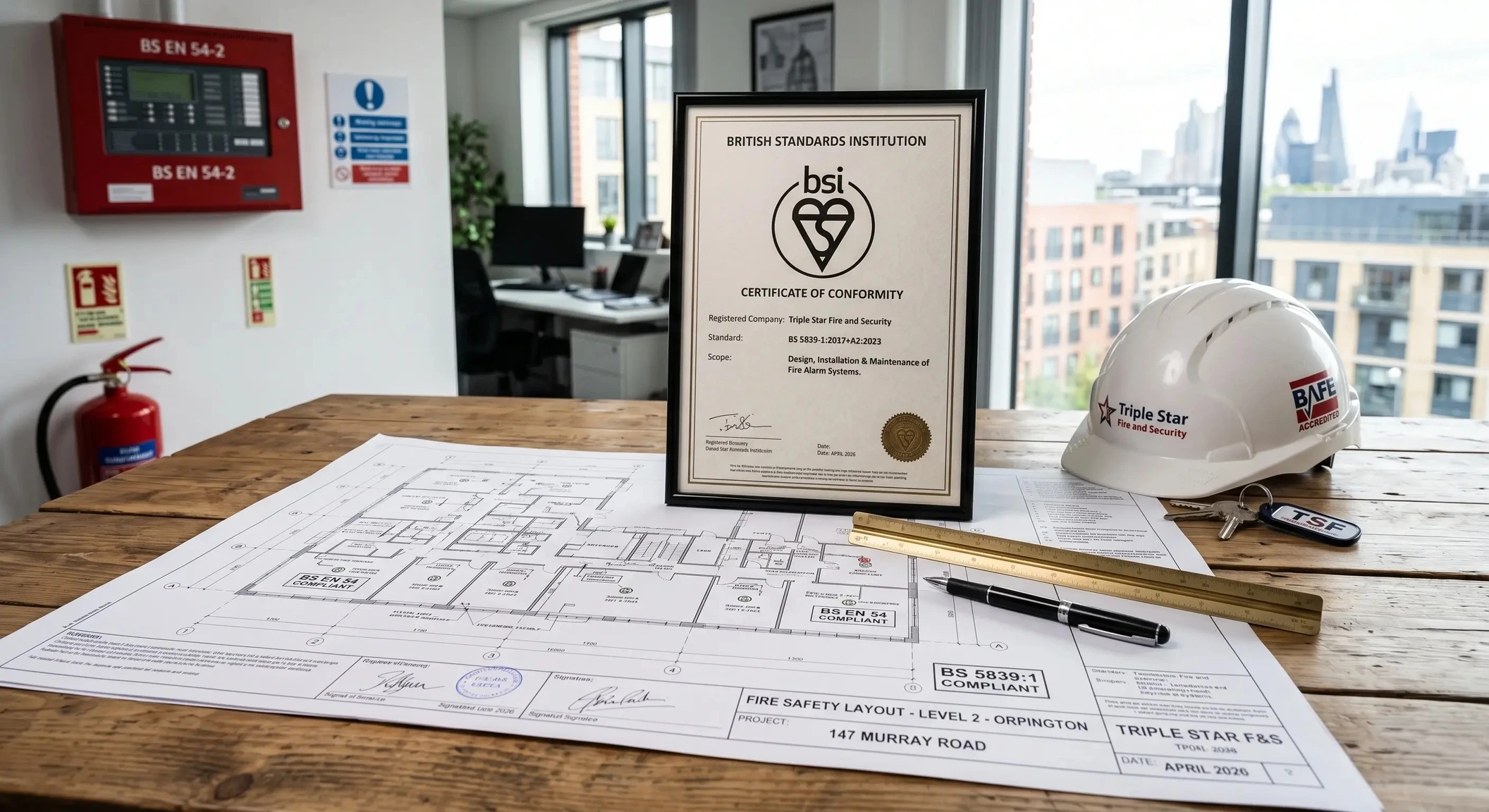
British Standards 5839 (BS 5839-1) is the one to know above all others. It sets out design, installation, commissioning and maintenance requirements for commercial fire alarm systems and is the document your engineer, your insurer and your fire risk assessor will all be working from. It categorises systems from L1 — the most comprehensive protection covering the whole building — down to L5 covering escape routes only, plus M for manual systems and P1/P2 categories for property protection. Any competent fire alarm engineer should be designing to BS 5839-1, and any commissioning certificate worth having will reference it by name. Our guide to commercial fire alarms covers the BS 5839-1 categories in more detail.
The Kitemark and Third-Party Certification
The Kitemark is BSI’s product certification mark. A Kitemark tells a buyer that a product has been independently tested against a named British Standard and that BSI continues to audit the manufacturer to confirm ongoing compliance. Kitemarked products go through an initial type test, a factory production control audit, and ongoing surveillance testing.
For fire and security equipment, the Kitemark is one of several third-party marks you will see on a panel or datasheet. Others include LPCB (the BRE’s Loss Prevention Certification Board) and CNPP. All three are recognised by UK insurers, and for most practical purposes you can treat them as interchangeable evidence of third-party certification against the relevant standard.
Third-party certification of installers — as distinct from the products they fit — is handled by separate bodies. For fire systems, BAFE is the principal UK scheme. For security systems, it is NSI or SSAIB. These bodies audit companies against the relevant British Standards and sector codes of practice. Triple Star is BAFE-accredited and SSAIB-approved, which means our design, installation and maintenance work is independently audited against the standards our clients specify.
BS, BS EN and BS EN ISO: What the Prefixes Mean
The prefix on a standard tells you how it relates to European and international frameworks. Once you know what the letters mean, a lot of the apparent complexity falls away:
- BS — a purely British Standard with no European or international equivalent
- BS EN — a British adoption of a European standard (CEN or CENELEC). Once adopted as BS EN, it replaces any conflicting national standard across all European member bodies
- BS ISO — a British adoption of an international standard (ISO or IEC)
- BS EN ISO — harmonised across British, European and international frameworks simultaneously
Most fire and security standards you will encounter today are BS EN, because the European market drove harmonisation from the late 1990s onwards. The practical result is that a fire alarm panel certified to BS EN 54-2 is accepted across the UK, the EU and many other markets without further testing — which is why manufacturers have consolidated their product ranges around the EN standards rather than maintaining separate national variants.
What Happens When a System Does Not Comply?
Non-compliance with the relevant British Standard rarely triggers a prosecution on its own — BS is not legislation. What it triggers is a chain of commercial and regulatory consequences:
- Insurers refuse cover, or load the premium — most commercial policies require BS-compliant fire and intruder systems as a condition of cover
- Fire risk assessments flag material deficiencies — which the Responsible Person under the Fire Safety Order 2005 must address within a reasonable period
- Enforcement action from the fire service — in the form of alteration notices, enforcement notices, or in serious cases prohibition notices stopping use of part or all of the premises
- Failed handovers — a landlord, managing agent or purchaser can refuse to accept a system that does not meet the specified standard, holding up occupation or completion
- Invalid commissioning certificates and building control sign-off — which can prevent a building opening for trading
The cost of retrofitting a non-compliant system is almost always higher than getting it right the first time. That is why any serious contractor quotes against the named British Standards rather than a generic specification, and why the commissioning certificate matters as much as the installation itself.
When to Call a Professional
If you are specifying a new fire or security system, taking over a site, or working through the actions on a fire risk assessment, you need a contractor who can certify their work against the relevant British Standards. That means BAFE third-party certification for fire, NSI or SSAIB for security, and engineers qualified to design to BS 5839 rather than just install to it.
A few signs it is time to pick up the phone:
- Your insurer has asked for written confirmation that the system complies with BS 5839-1
- A fire risk assessment has flagged your current system as Category L5 when it should be L3 or higher
- You have inherited a system with no commissioning certificate or documented design category
- The building has changed use and the original standard no longer fits the occupancy
- Testing and maintenance records are incomplete, missing, or held on paper that nobody can find
Triple Star is BAFE-accredited and SSAIB-approved, and we have been designing, installing and maintaining commercial fire safety systems across Orpington, Kent and Greater London since 2006. For ongoing compliance, many of our clients use our Digital Fire & Security Logbook to keep BS 5839 testing and maintenance records in one place rather than in a folder on a shelf.
Frequently Asked Questions
Are British Standards legally required?
Not directly. Compliance with a specific British Standard is almost always voluntary in law. However, the Regulatory Reform (Fire Safety) Order 2005 places a duty on the Responsible Person to take reasonable steps to protect people from fire, and compliance with the relevant BS is the recognised way to demonstrate that. Insurers, fire risk assessors and local authorities all treat BS compliance as the practical standard of care, which means non-compliance carries real commercial and regulatory consequences even without a direct legal mandate.
What is the difference between BS, BS EN and BS ISO?
BS is a standard published only in the UK. BS EN is a British adoption of a European standard from CEN or CENELEC, and once published it replaces any conflicting national standard across European member bodies. BS ISO is a British adoption of an international standard from ISO or IEC. BS EN ISO indicates a standard that is harmonised across all three frameworks simultaneously. Most current fire and security standards — including BS EN 54 and BS EN 50131 — are BS EN or BS EN ISO.
How often are British Standards updated?
BSI reviews each standard at least every five years, and active standards are often updated more frequently. BS 5839-1, for example, has had several amendments since its 2017 edition. When referencing a standard in a contract or specification, always cite the current year and amendment — for example, BS 5839-1:2017+A2:2023. Referencing an outdated edition in a specification can create ambiguity about which version a contractor is being asked to comply with.
What is British Standards 5839?
British Standards 5839 (BS 5839) is the code of practice for fire detection and alarm systems in UK buildings. It has two main parts: BS 5839-1 covers non-domestic premises — offices, warehouses, care homes, retail units, and any commercial or industrial building — while BS 5839-6 covers domestic properties. For commercial clients, BS 5839-1 is the document that matters. It defines how a fire alarm system should be designed, installed, commissioned and maintained, and sets out system categories from L1 (full building coverage) down to L5 (escape routes only), plus M for manual systems and P1/P2 for property protection. A commissioning certificate on a compliant system should always reference the BS 5839-1 design category.
Do I need Kitemarked equipment on a commercial fire alarm system?
Not strictly. BS 5839-1 requires that components meet BS EN 54, and third-party certification — Kitemark, LPCB or an equivalent scheme — is the standard way to evidence that they do. In practice, UK insurers and fire risk assessors expect to see third-party certified products on commercial systems, and most specifications make this requirement explicit. Specifying non-certified components creates uncertainty about whether the system genuinely meets the standard it claims to.
Where can I buy British Standards?
Official copies are available from the BSI Shop on the BSI Group website, either as individual PDFs or hard copies. Organisations with regular need can subscribe to BSI Knowledge for library-style access to the full catalogue. Trade bodies such as the FIA and BAFE also publish plain-English guides that summarise the key requirements of the main fire and security standards in a format more accessible than the standards documents themselves.
Who enforces British Standards?
Nobody enforces British Standards directly — they are not legislation. Enforcement comes indirectly, through the Fire and Rescue Service operating under the Fire Safety Order, the HSE under the Health and Safety at Work Act, Building Control under the Building Regulations, and — most practically for most businesses — insurers who decline to cover premises with non-compliant systems. The cumulative effect is that BS compliance is effectively mandatory for any commercial site, even though no single piece of legislation requires it by name.
If you need a BS-compliant fire or security system designed, installed or maintained for a commercial site, call Triple Star Fire & Security on 0203 189 1960, email info@tsfands.com, or use our contact page. Triple Star Fire & Security, Unit 2, Murray Business Centre, Murray Road, Orpington, BR5 3RE.
Sources
- British Standards Institution (BSI Group) — the publisher of all British Standards
- Regulatory Reform (Fire Safety) Order 2005 — legislation.gov.uk
- Fire Industry Association (FIA) — UK fire industry guidance and BS 5839 commentary
- BAFE — third-party certification for the UK fire safety industry
- National Security Inspectorate (NSI) — security systems certification
- SSAIB — certification for security, fire and telecare systems