
How Often Should Fire Alarms Be Tested?
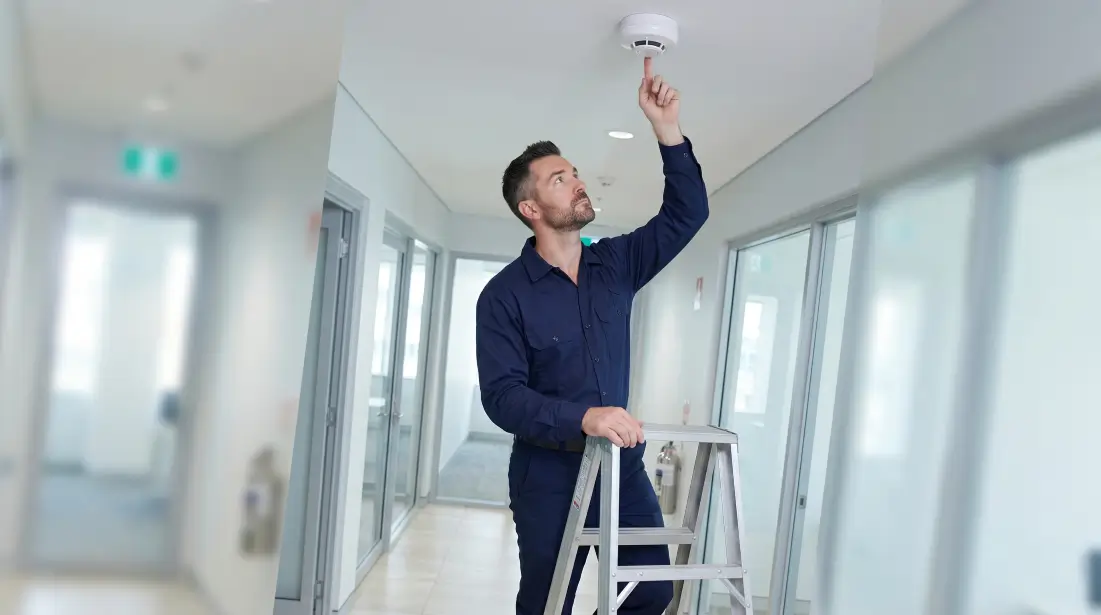
How often should fire alarms be tested? It is one of the most common questions we hear from facilities managers, landlords, and business owners across Orpington, Kent, and Greater London — and the honest answer is: more often than most people realise. In the UK, fire alarm testing frequency is governed by BS 5839-1:2017, the British Standard covering the design, installation, commissioning, and maintenance of fire detection and alarm systems. Alongside it, the Regulatory Reform (Fire Safety) Order 2005 places a legal duty on the responsible person to keep fire detection systems in efficient working order — and fire alarm testing regulations in the UK are clear that this is an ongoing obligation, not a once-a-year task. In our experience, a large proportion of commercial premises are either testing too infrequently, failing to log results correctly, or relying on a single annual visit that simply does not meet the standard. This guide explains the full fire alarm maintenance schedule and why each layer matters.
What BS 5839-1 Requires: The Three-Tier Maintenance Schedule
BS 5839-1:2017 — the Code of Practice for the design, installation, commissioning, and maintenance of fire detection and alarm systems — divides maintenance activity into three distinct tiers, each with a different frequency and a different level of technical competence required to carry it out.
The three tiers are:
- Weekly routine tests — carried out by the responsible person or a designated building staff member
- Six-monthly inspections — carried out by a competent fire alarm engineer, at intervals not exceeding six months
- Annual review — a comprehensive service that in practice is typically delivered across the two six-monthly engineer visits
Some higher-risk premises — hospitals, care homes, large residential blocks, or buildings with a BS 5839-1 Category L1 system providing full automatic detection — may need additional intermediate inspections. Your fire risk assessment and system log book will confirm what applies to your building.
It is worth noting that BS 5839-1 is not a legal instrument in itself, but it is the standard to which fire and rescue authorities, insurers, and courts will refer when assessing whether your system has been maintained adequately. Following it is, in practical terms, a legal requirement.
Weekly Fire Alarm Testing: What You Need to Do
The weekly test is the layer of maintenance that falls to the building’s responsible person — not an engineer. It does not require specialist tools or training, but it does require consistency and accurate record-keeping.
Each week, at least one manual call point (also called a break-glass unit or MCP) should be activated. The key word here is rotation: you should work through your call points systematically, so that each device is tested at least once every few months rather than always activating the same unit. When you activate the call point, you are checking that:
- The alarm panel registers the signal and shows the correct zone
- All sounders activate throughout the building
- Any visual alarm devices (VADs) are functioning
- Where a remote monitoring or alarm receiving centre (ARC) connection exists, the signal is received correctly (and can be cancelled before an attendance is dispatched)
The test should be carried out at a consistent time each week — during working hours, so that occupants are aware it is a test. Critically, every test must be logged in the system’s fire alarm logbook or digital record. BS 5839-1 is explicit: an untested or an unlogged system is a non-compliant system. A fire authority inspector can request logbook records at any time during an inspection, and the absence of records is treated as a failure to test.
If your building uses a digital fire and security logbook, this is the right place to record weekly test results along with the zone and call point tested. Paper logbooks are equally valid, but make sure they are stored securely and retained for the recommended period.
Six-Monthly Engineer Inspections: What They Cover
Every six months — or at intervals of not more than six months — a competent fire alarm engineer should carry out a full inspection of your system. This goes well beyond what the weekly test is able to verify.
A six-monthly service typically includes the following activities:
- Testing every manual call point across all zones
- Testing every automatic detector (smoke, heat, multi-sensor, beam), including simulated activation where appropriate
- Checking all sounders and visual alarm devices for correct operation and adequate volume
- Inspecting the main control panel and any repeater panels
- Testing the battery standby power under load conditions
- Checking cable integrity, connections, and conduit where accessible
- Reviewing the cause-and-effect configuration against the original system design
- Updating the system logbook and producing a written service report
- Identifying any devices that are dirty, physically damaged, or showing signs of impending failure
In our experience, premises that rely on a single annual visit — and skip the intermediate six-monthly inspection — often accumulate undetected faults between services. Detector contamination, failing standby batteries, and degraded sounder elements are the most common findings. None of these announce themselves between inspections; only systematic testing by a competent engineer will identify them.
For wireless fire alarm systems, six-monthly inspections are particularly important because battery condition and radio signal strength require regular monitoring. A wireless detector with a depleted battery will not provide the protection it appears to be providing.
The Annual Service: What a Comprehensive Review Involves
The annual service draws together the findings from both six-monthly visits and provides a complete picture of system health and compliance. In practice, most engineers structure the annual review to coincide with the second six-monthly visit, producing a more detailed report at that point.
The annual service report should include:
- A summary of all devices tested and their condition
- Any defects identified during the year and confirmation of remedial action taken
- Confirmation that the system is operating in accordance with BS 5839-1
- Recommendations for the coming year, including any devices approaching end of life
- An updated cause-and-effect matrix if the system configuration has changed
If your premises is subject to a fire risk assessment under the Regulatory Reform (Fire Safety) Order 2005, the annual service report forms a core part of your compliance documentation. Many commercial insurers now explicitly request a copy of the most recent fire alarm service report when renewing or settling claims. A claim made following a fire at premises where the alarm was not maintained in accordance with BS 5839-1 may be contested.
Fire Alarm Testing Frequency and Maintenance Schedule at a Glance
The table below summarises the standard fire alarm maintenance schedule under BS 5839-1 for most commercial premises in the UK. Higher-risk or more complex systems may require additional intermediate checks — consult your engineer and fire risk assessment for site-specific requirements.
| Activity | Frequency | Who Carries It Out | What Is Checked |
|---|---|---|---|
| Manual call point activation (by rotation) | Weekly | Responsible person / building staff | Panel response, sounder activation, ARC signal (where fitted) |
| Visual inspection of detectors and panel | Monthly (recommended) | Responsible person | Physical condition, indicator LEDs, battery charge warnings |
| Full system inspection | Every six months | Competent fire alarm engineer | All call points, detectors, sounders, VADs, panel, batteries, cabling |
| Comprehensive annual service and report | Annually | Competent fire alarm engineer | Full system review, cause-and-effect verification, compliance confirmation, recommendations |
Fire Alarm Testing in Residential Buildings, Blocks of Flats, and HMOs
The testing schedule above applies to commercial and non-domestic premises. If you are a landlord or managing agent responsible for a residential building, block of flats, or house in multiple occupation (HMO), the requirements are slightly different but equally important.
For HMOs, the Management of Houses in Multiple Occupation (England) Regulations 2006 requires that fire detection and alarm systems are maintained in good working order. In practice this mirrors the BS 5839-1 framework: weekly tests (or at least a test at the start of each tenancy), six-monthly engineer inspections, and an annual service. Many local authorities with HMO licensing conditions will specify testing frequency explicitly in the licence conditions, so it is worth checking yours.
For purpose-built blocks of flats, fire alarm systems in common areas (corridors, stairwells, plant rooms) must be tested and maintained in the same way as other non-domestic premises under the Regulatory Reform (Fire Safety) Order 2005. Individual flats within the block fall under different legislation, but any common-area detection system is the freeholder’s or managing agent’s responsibility to maintain.
In both cases, the principle is the same: weekly functional tests, six-monthly engineer inspections, and accurate record-keeping. If you are unsure whether your residential block or HMO fire alarm system is being maintained to the correct standard, our team can carry out an assessment and bring your maintenance schedule up to date.
Who Is Responsible for Fire Alarm Testing?
The Regulatory Reform (Fire Safety) Order 2005 designates a “responsible person” for all non-domestic premises. In a workplace, this is typically the employer. In a building with common areas, it is usually the landlord or managing agent. Where responsibility has been formally delegated, it should be confirmed in writing. The responsible person cannot discharge their legal duty simply by appointing a maintenance contractor — they must ensure that fire alarm testing is carried out at the correct frequency, that results are logged accurately, and that any defects identified are remedied promptly.
In multi-tenancy commercial buildings, responsibility is often split: the landlord or managing agent holds responsibility for fire alarm systems in common areas (corridors, stairwells, plant rooms), while individual tenants may hold responsibility for detection within their own demise. This division should be set out clearly in the lease and reviewed as part of the fire risk assessment. In a workplace with a single tenant, the employer as responsible person should ensure that whoever carries out weekly tests — a facilities manager, a building manager, or a designated member of staff — has been briefed properly and is logging every result.
Nine times out of ten, when we attend a building where the fire alarm has not been maintained correctly, the issue is not wilful neglect — it is a lack of clarity about who is responsible for booking the engineer visits. Getting this clearly documented in writing, with a named contact and a diary reminder for each service, prevents the problem from recurring.
The British Standards covering fire alarm systems — including BS 5839-1 — are worth reviewing if you want a deeper understanding of the technical framework that sits behind your maintenance obligations.
When to Call an Engineer Outside of Planned Servicing
Planned servicing forms the foundation of fire alarm maintenance, but there are circumstances that warrant an unplanned engineer visit:
- Persistent false alarms. Occasional false activations are not uncommon, but a pattern of false alarms usually indicates detector contamination, incorrect siting of a device, or a wiring fault. The fire service will charge for repeated false alarm attendances in some areas, and persistent false alarms lead to alarm fatigue — occupants begin to ignore the system, which is a serious life-safety risk.
- Panel fault warnings. Any fault indicator on the control panel that cannot be reset, or that recurs, should be investigated by an engineer rather than simply acknowledged and left.
- Physical damage to components. A broken call point cover, a detector that has been knocked out of position, or a sounder that has been tampered with should be reported and repaired promptly.
- Building alterations. Any refurbishment, partition change, or change of use that affects the layout of a floor may affect detector coverage and the cause-and-effect configuration. An engineer should review the system before the changes go live, not after.
- A genuine activation followed by no fire. If your alarm activates and there is no apparent cause, it should be investigated rather than assumed to be a false alarm. The cause should be logged and, if it cannot be identified by the responsible person, reported to the engineer at the next service or sooner if it recurs.
Frequently Asked Questions
How often should fire alarms be tested in a workplace?
In a workplace in the UK, fire alarms should be tested at least weekly — a manual call point should be activated (by rotation across all call points) and the result logged in the fire alarm record. A competent engineer must also carry out a full inspection at least every six months, and a comprehensive annual service report should be produced. This fire alarm testing frequency applies to the vast majority of non-domestic premises under BS 5839-1:2017 and the Regulatory Reform (Fire Safety) Order 2005.
Is weekly fire alarm testing a legal requirement?
Weekly testing is not set out as an explicit legal requirement in a specific piece of legislation, but the Regulatory Reform (Fire Safety) Order 2005 requires the responsible person to ensure that fire alarm systems are maintained in efficient working order — and BS 5839-1 (the standard fire authorities and courts use to assess this) specifies weekly testing as the minimum routine testing frequency. In practice, failure to test weekly will be treated as a compliance failure during a fire authority inspection.
Do I need an engineer to test my fire alarm every week?
No. The weekly test — activating a manual call point and logging the result — is designed to be carried out by a trained member of building staff, not a specialist engineer. What does require a competent engineer is the six-monthly inspection and the annual service. The engineer’s role is to test all devices (including automatic detectors), check batteries, inspect cabling, and produce a formal service report.
How long does a fire alarm service take?
It depends on the size of the system. A small single-zone system in a modest commercial premises might take two to three hours. A large multi-zone addressable system across several floors of a commercial building could take a full day, or require two separate visits to complete. Your engineer should give you an estimated duration when booking the service.
What happens if my fire alarm is not tested regularly?
Inadequate testing puts building occupants at risk and exposes the responsible person to enforcement action under the Regulatory Reform (Fire Safety) Order 2005, which can include formal enforcement notices, prohibition notices, and in serious cases prosecution. Insurers may also challenge claims if the fire alarm system cannot be demonstrated to have been maintained in line with BS 5839-1. Beyond the regulatory and financial consequences, undetected faults — failed sounders, contaminated detectors, flat batteries — mean that the system may not operate correctly in an actual fire.
How often should fire alarms be tested in a block of flats or HMO?
In a block of flats, fire alarm systems in common areas (corridors, stairwells, plant rooms) fall under the Regulatory Reform (Fire Safety) Order 2005 and should follow the same BS 5839-1 testing schedule as commercial premises: weekly functional tests and at least two engineer inspections per year. For HMOs, the Management of Houses in Multiple Occupation Regulations 2006 requires that fire detection systems are kept in good working order, with many local authority licensing conditions specifying the testing frequency explicitly. In both cases, the landlord or managing agent is the responsible person for common-area systems.
Can I use a digital logbook to record fire alarm tests?
Yes. A digital fire alarm logbook is fully acceptable under BS 5839-1 and the Regulatory Reform (Fire Safety) Order 2005, provided it records the required information accurately and is accessible for inspection. Digital logbooks have the advantage of creating an automatic audit trail and allowing easy access for remote review by your maintenance contractor or fire risk assessor.
If your fire alarm is overdue for a service, or you are not certain your current maintenance schedule meets BS 5839-1, call Triple Star Fire & Security on 0203 189 1960, email info@tsfands.com, or use our contact page. Triple Star is BAFE-accredited and SSAIB-approved, providing fire alarm installation, servicing, and maintenance across Orpington, Kent, and Greater London. Triple Star Fire & Security, Unit 2, Murray Business Centre, Murray Road, Orpington, BR5 3RE.